



Leeward Financial Partners
Markets experienced a strong recovery during the second quarter, reversing the sharp decline seen in March. Factors such as strong corporate earnings, easing geopolitical concerns, and resilient economic data helped restore investor confidence. However, enthusiasm cooled towards the end of the quarter as rising inflation figures introduced new uncertainty regarding the future path of interest rates.
After a decline of 4.8% in the first quarter, the S&P 500 rebounded significantly with a gain of 15.1% in Q2, bringing its year-to-date return to 10.1%. Small-cap stocks, as represented by the Russell 2000 Index, rose 22.6% in the first half of the year, marking their strongest start since 1991. While this performance is noteworthy, much of the outperformance has merely narrowed the substantial performance gap that developed between small-cap and large-cap stocks over the past decade.
One of the key investment narratives for the first half of the year was not just about artificial intelligence (AI) overall, but the significant performance disparity within the AI ecosystem itself. According to J.P. Morgan's classification, around 40 "AI-related" companies in the S&P 500 returned 5.7% in the first six months of the year, while the other approximately 460 companies returned 10.2%. This is mostly due to the market capitalization of underperforming hyperscalers (MSFT, AMZN, etc) and software companies.
This disparity highlights a notable divergence beneath the surface. Semiconductor companies positioned at critical points in the AI supply chain delivered outstanding returns. Investors have responded positively, driven by expectations that hyperscalers will invest about $2.7 trillion in AI infrastructure by the end of 2028 (see Figure 1 below).
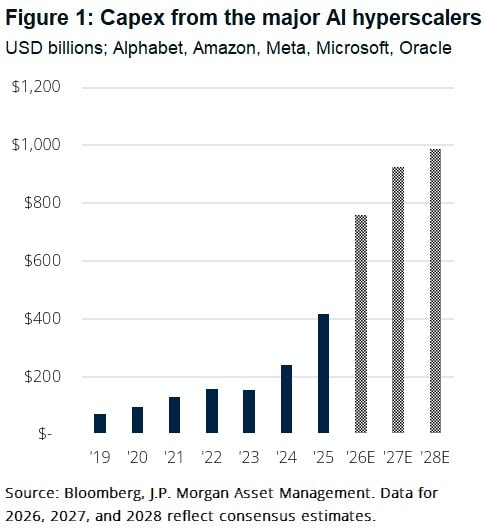
Hardware and power companies showcased strong performances, while some large-cap tech stocks experienced minor dips. Interestingly, software companies faced challenges, largely influenced by the narrative surrounding advanced AI agents suggesting that "software is dead."
Take a look at Figures 2 and 3 below, which provide an overview of the AI ecosystem, detailing its segments, their index weights, and year-to-date returns.
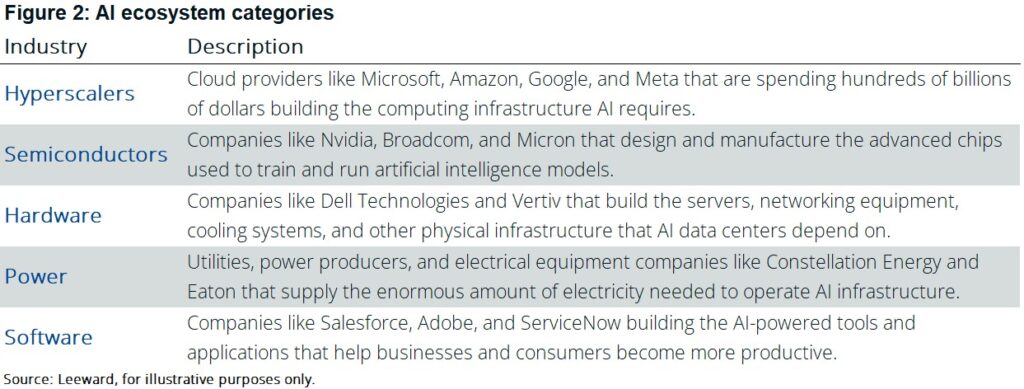
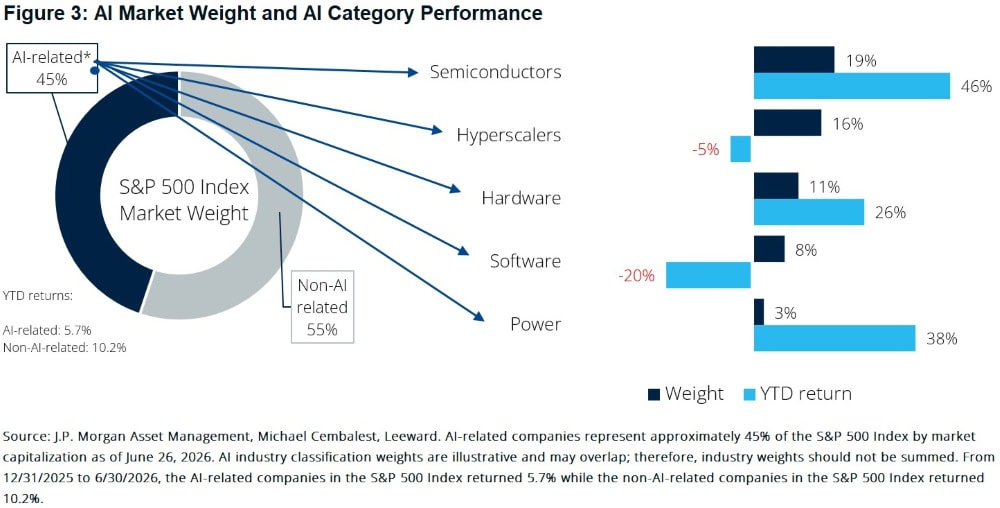
While AI will inevitably disrupt some software companies, we believe the market's broad dismissal of the sector has been overly pessimistic. In our view, this has created opportunities to selectively build positions in high-quality software companies whose long-term competitive advantages remain intact.
Outside the U.S., International equities in Europe and Japan gained 8.6% during the second quarter, trailing the 15.1% return of U.S. equities. Emerging market equities rose 19.7%, driven largely by Taiwan and South Korea, home to AI leaders such as TSMC and Samsung. Even so, elevated index concentration, currency exposure, and other structural considerations continue to support our underweight allocation to emerging markets.
In fixed income, rising inflation expectations pushed interest rates higher, limiting second-quarter bond returns to 0.7%. Those inflation concerns were driven primarily by developments in Iran, which we discuss in the next section.
While conditions in Iran continue to evolve, financial markets have largely looked through the latest developments. Barring a meaningful escalation, investors appear focused on the conflict's economic consequences rather than the daily headlines. Although defense spending across the region is likely to increase, history suggests those themes are surprisingly difficult to invest in. Despite the heightened geopolitical backdrop, the U.S. aerospace and defense industry has underperformed the broader market by nearly 9% year-to-date.
Crude oil prices surged during the early stages of the conflict but have since retraced most of those gains, easing concerns about a more persistent economic impact. As we've noted in previous commentaries, energy prices remain the primary link through which Middle Eastern conflicts affect the broader economy and financial markets. Figure 4 illustrates the initial spike and subsequent decline in oil prices.
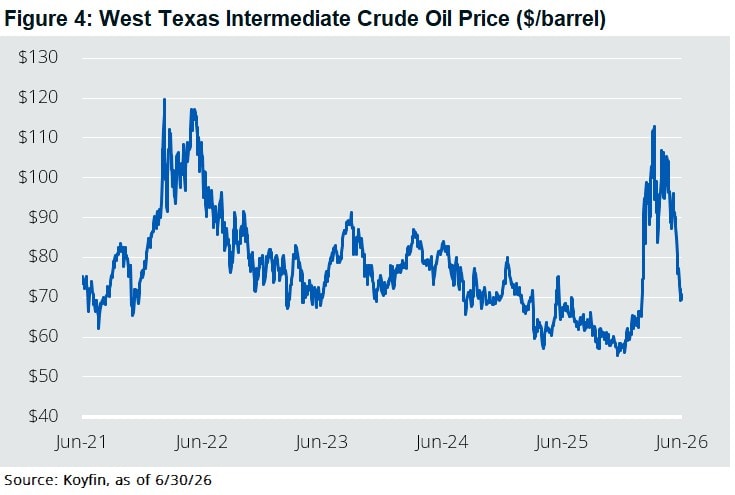
For now, we continue to view developments in the Middle East as impacting inflation and interest rates, but not a reason to alter portfolio positioning. Although oil prices have stabilized, inflation risks remain somewhat tilted to the upside due to uncertainties regarding trade and foreign policy. Markets still see a considerable chance of one or two additional Federal Reserve rate hikes over the next year.
The key question is whether inflation remains largely confined to energy or begins spreading more broadly throughout the economy. Historically, the Federal Reserve has been inclined to overlook temporary energy-driven inflation because monetary policy has little influence over commodity price shocks. However, if higher energy costs start to influence wages and the prices of other goods and services, the case for additional rate hikes would strengthen considerably.
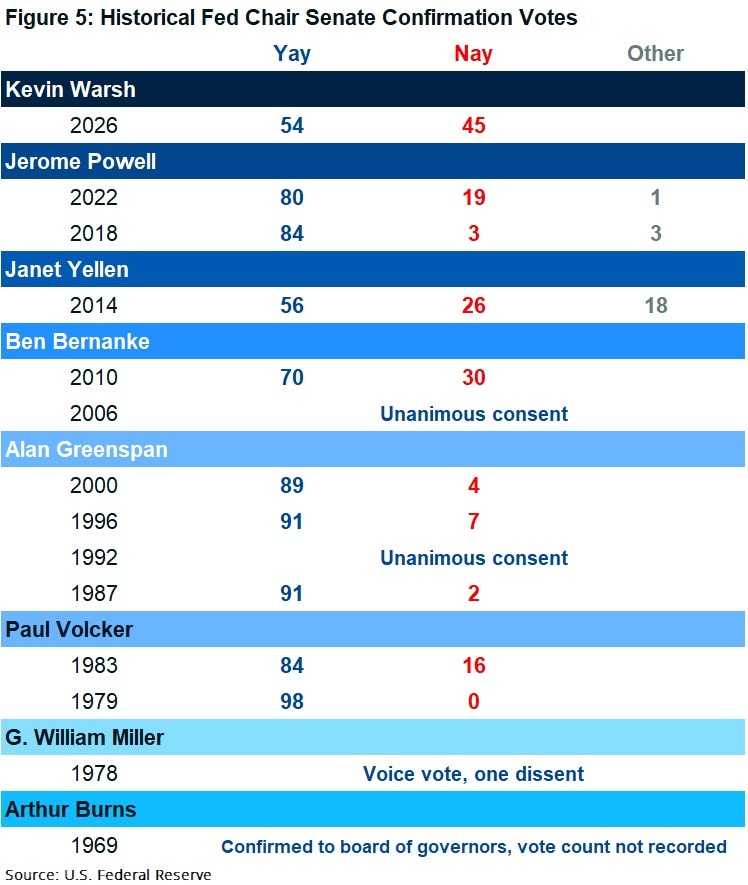
Kevin Warsh succeeded Jerome Powell as Chair of the Federal Reserve following one of the closest and most partisan confirmation votes (see Figure 5 below) in the institution's history. While President Trump has advocated for lower interest rates, the economic backdrop has yet to present a compelling case to ease monetary policy.
Warsh's most significant change has been in how the Federal Reserve communicates with the markets, rather than in its actual monetary policy. At its June meeting, the Fed shortened its policy statement from 341 words to just 132, eliminating much of the forward guidance that had previously indicated where interest rates were likely to head. Supporters argue that this shift keeps the Fed focused on economic data instead of market expectations, while critics believe it removes an important tool for reducing uncertainty. Regardless, investors should likely anticipate more policy surprises than in recent years.
Ultimately, interest rates will be determined by economic conditions rather than the Fed's communication style. The labor market remains strong, with unemployment at 4.3% and payroll growth averaging approximately 92,000 jobs per month year-to-date, aligning with long-term averages. Inflation has begun to rise but is primarily concentrated in energy prices, rather than being widespread across the economy. If this changes, additional rate hikes would be more likely. For now, the combination of a robust labor market and only modestly elevated inflation suggests there is little urgency to lower interest rates, leaving the Federal Reserve with a bias toward one or two additional hikes over the next six to nine months.
While much of our focus has been on the economic forces driving the economy, the broader investment world was captivated in June by the highly anticipated initial public offering (IPO) of SpaceX. The stock <SPCX> initially priced at $135/share and traded as high as $228/share. As of this writing, however, SpaceX stock is trading at $125, $10 below its initial offering price of $135. A quick reversal for a company that has been public for less than a month.
The SpaceX offering is notable because of its size and media focus. The financing shattered records, becoming both the largest IPO by capital raised (approximately $75 billion) and the largest company ever to go public, with an initial market capitalization of roughly $1.75 trillion.
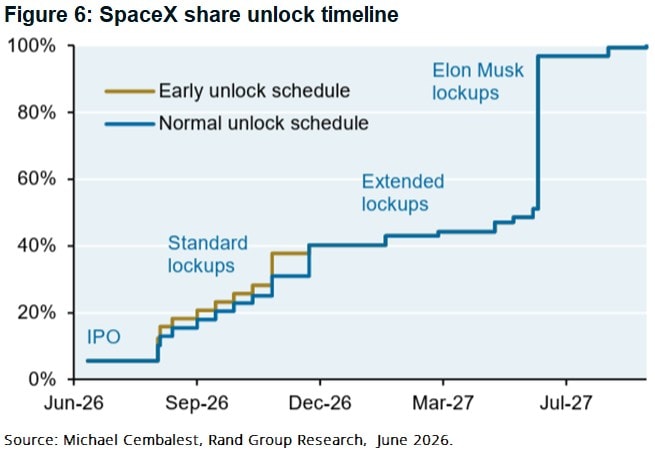
The first record, the amount of capital raised, reveals surprisingly little about how much of the company actually became available for trading. Although SpaceX was initially valued at around $2 trillion, only about 5% of its shares were sold in the IPO. In investment terms, this 5% is called the “float”, meaning the percentage of shares that are actually available to be purchased publicly. The remaining shares, primarily held by founders, employees, and early investors, will become eligible for sale gradually over the coming year as lock-up restrictions expire. While this staged release helps prevent the market from being flooded with new sellers, it also means that roughly 95% of shareholders have not yet had an opportunity to monetize their positions. Typically, these insiders have a low cost basis and are motivated to sell at any price. This is a risk for anyone who buys <SPCX> shares in the public markets.
Figure 6 illustrates the expected lock-up schedule.
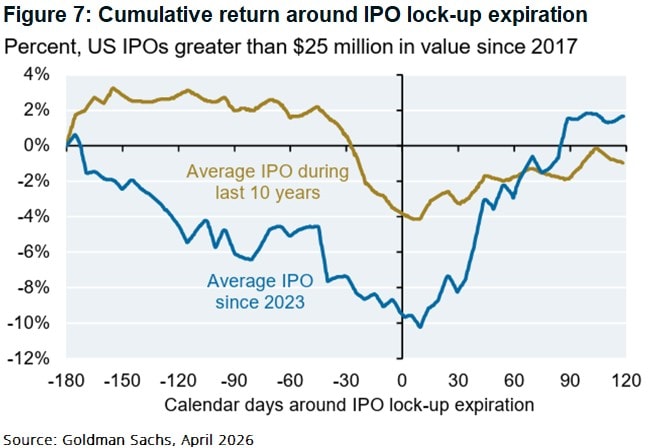
This dynamic is not unique to SpaceX. For most IPOs, insider lock-up restrictions expire roughly 180 days after the offering, and history suggests that investors who wait until after these periods generally achieve better returns than those who buy during the initial excitement. Figure 7 illustrates this historical pattern.
The second record, becoming the largest company ever to go public, highlights how dramatically capital markets have evolved. Decades ago, rapidly growing businesses relied on public markets to finance their expansion. Today, abundant private capital allows many companies to remain private for much longer, meaning much of their value creation occurs before public investors have an opportunity to participate. Today, the IPO serves less as a source of growth capital and more as a mechanism for founders, employees, and early investors to monetize a portion of their holdings.
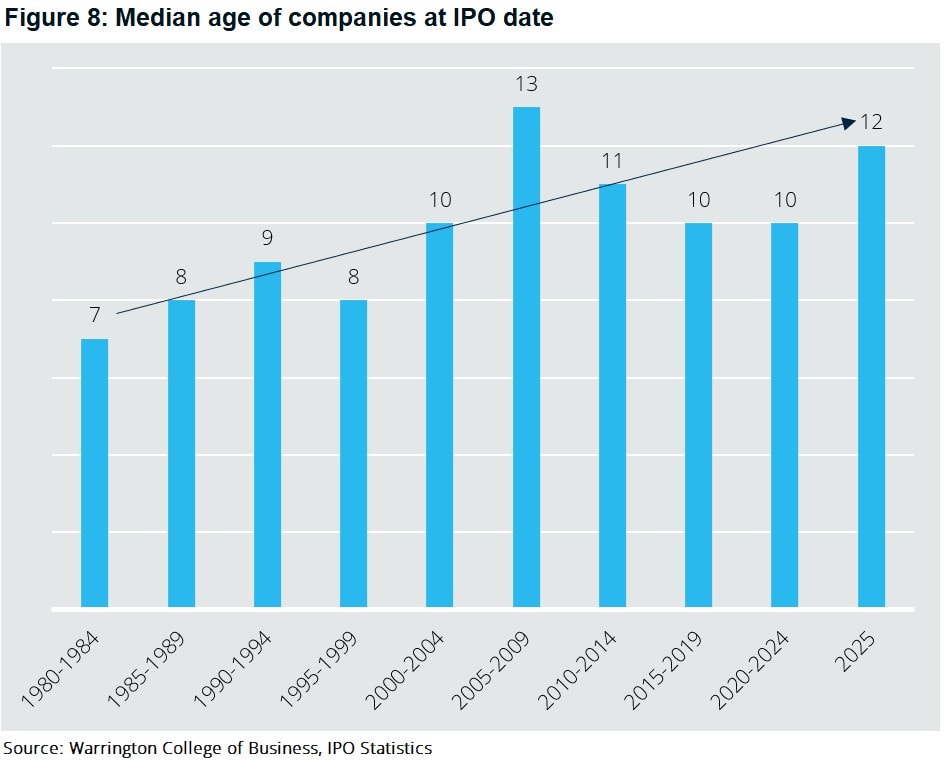
This distinction is important. Companies like Amazon and Google entered the public markets at a much earlier stage of their development than today's mega-IPOs. SpaceX, by contrast, debuted as the sixth-largest publicly traded company in the United States with a market capitalization approaching $2 trillion. Companies coming public today are generally older (Figure 8 below), more established, and therefore carry less business risk, but also less potential upside.
In our 30 years of investment experience, we have seen a dramatic decline in the attractiveness of initial public offerings. With several high-profile offerings, including Anthropic and OpenAI, expected soon, we believe investors should focus less on the excitement surrounding the first day of trading and more on valuation, entry point, and long-term fundamentals.
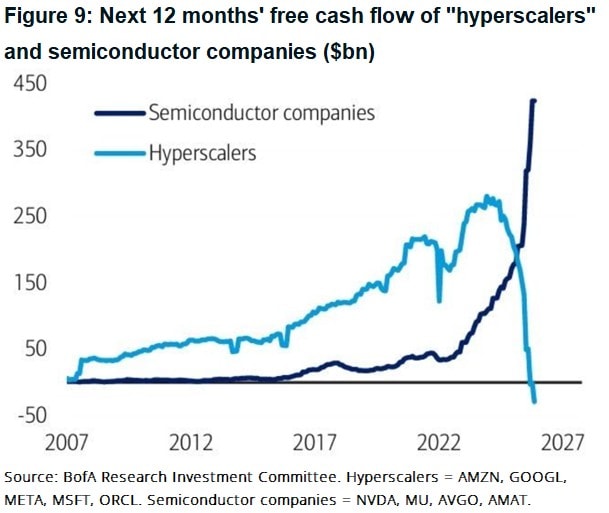
Looking ahead, the economic backdrop remains constructive. Although GDP growth has moderated from its post-pandemic pace, the economy continues to expand at an above-trend rate. In the first quarter, GDP grew 2.1%. Much of that strength is being driven by business investment, particularly the spending on artificial intelligence infrastructure. As the largest technology companies continue investing hundreds of billions of dollars in data centers (see Figure 9 below), semiconductors, networking equipment, and power infrastructure, those expenditures are supporting economic activity well beyond the technology sector.
Businesses continue to navigate an uncertain trade environment, with imports remaining near record levels as companies adjust supply chains and inventory strategies. While this may weigh modestly on GDP, it also reflects resilient domestic demand that should continue supporting corporate revenues and earnings. According to FactSet, S&P 500 earnings are expected to grow approximately 24% year-over-year in both the second quarter and full-year 2026, followed by another 17% in 2027. If realized, those growth rates would leave current equity valuations looking attractive.
The consumer remains a primary area of weakness. Consumer sentiment is subdued as inflation (4.3%) has recently outpaced wage growth (3.6%), reducing purchasing power and contributing to rising stress in household balance sheets. Delinquencies on credit card and auto loans have also increased, though these pressures have yet to translate into a meaningful slowdown in consumer spending or corporate earnings. For now, a resilient labor market, strong business investment, and robust earnings expectations continue to outweigh those risks.
Broadly speaking, we continue to allocate capital to the areas of the economy that are driving earnings growth. During the quarter, we increased exposure to companies participating in the industrial and AI infrastructure buildout, selectively added pro-cyclical financials, and expanded positions in health care where valuations were attractive. We remain underweight Consumer Discretionary and Consumer Staples, while continuing to avoid the Energy sector given the unpredictable geopolitical backdrop.
In June, we also completed our quarterly portfolio rebalance, making modest adjustments to sector allocations and individual holdings to ensure portfolios remained aligned with our investment thesis and the evolving market environment. Within fixed income, we reduced portfolio duration to lessen sensitivity to any additional interest rate increases.
Internationally, we remain underweight despite recognizing attractive opportunities in select emerging market companies benefiting from the global AI investment cycle. More broadly, however, elevated index concentration, currency risk, and a less compelling earnings backdrop continue to make U.S. equities the more attractive destination for capital.
It has been a strong year for investors thus far. The S&P 500 has returned approximately 10%, while bonds have also generated positive returns despite higher interest rates. As we've discussed throughout this commentary, the economic backdrop remains constructive, earnings expectations continue to improve, and equity valuations appear reasonable. Taken together, those factors leave us optimistic that markets can continue moving higher through year-end.
While volatility is inevitable, we believe the AI infrastructure investment cycle will continue to support earnings growth and broaden participation in the market's advance. The primary risks remain familiar: a meaningful escalation in Iran, a sustained rise in oil prices, or a resurgence in inflation that forces the Federal Reserve to tighten policy more aggressively than expected. For now, however, those risks appear manageable.
Looking ahead, investor attention will gradually shift toward the 2026 midterm elections and their implications for fiscal, trade, and regulatory policy. While visibility into 2027 remains limited, our investment philosophy remains unchanged: follow the earnings. As always, thank you for your continued trust and partnership. We sincerely appreciate the opportunity to manage your investments and are always available to discuss your portfolio or answer any questions.
Sincerely,
Leeward Financial Partners


